Alarm Fatigue in Modern Telecom Networks
Why more alarms don’t always mean better visibility—and how intelligent automation is changing telecom operations.
Every Network Operations Centre (NOC) is built around one core objective: detect problems early and resolve them before customers are impacted.
Yet many telecom operators face an unexpected challenge—not too few alarms, but far too many.
As networks continue to grow in size and complexity, NOCs are overwhelmed with thousands of alarms every day. Instead of improving visibility, this flood of notifications often creates confusion, slows response times, and increases operational costs.
This phenomenon is known as alarm fatigue, and it’s becoming one of the biggest operational challenges facing modern telecom networks.
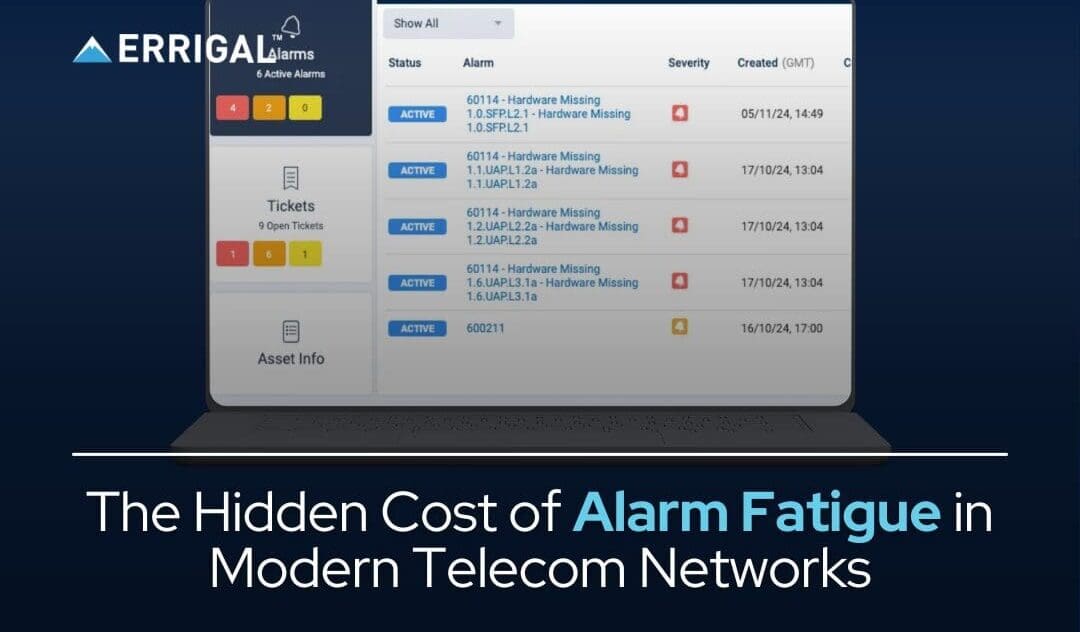
When More Alarms Mean Less Visibility
On the surface, generating thousands of alarms appears to provide comprehensive network monitoring. In reality, the opposite is often true.
A single hardware failure can trigger dozens—or even hundreds—of related alarms across connected devices and services. Engineers are forced to sift through duplicate notifications, secondary symptoms, and cascading events before identifying the original cause.
Instead of focusing on resolving the issue, valuable time is spent determining which alarms actually matter.
The result is a Network Operations Centre that is busy, but not necessarily productive.
The Real Cost of Alarm Fatigue
Alarm fatigue impacts far more than the engineering team. It has measurable consequences across the entire organisation.
Slower Mean Time to Resolution (MTTR)
When engineers must manually review hundreds of alarms, identifying the root cause takes longer. Every additional minute spent investigating increases the overall time required to restore service.
Ticket Flooding
Many traditional monitoring platforms automatically generate a new ticket for every qualifying alarm.
A single network outage can easily produce dozens of tickets relating to the same underlying issue.
This creates unnecessary administrative work, duplicates engineering effort, and makes it difficult to prioritise genuine incidents.
Missed Critical Events
Perhaps the greatest danger of alarm fatigue is that genuinely critical events become buried beneath less important notifications.
When operators receive thousands of alarms every day, important incidents become increasingly difficult to distinguish from routine network noise.
Increased Operational Costs
Every unnecessary alarm consumes engineering time.
Whether it’s investigating duplicate events, managing redundant tickets, or escalating non-critical issues, excessive alarms directly increase operational expenditure while delivering little additional value.
Why Traditional Alarm Monitoring Falls Short
Many legacy monitoring platforms still rely on a relatively simple process:
- Device generates an alarm.
- Alarm enters the monitoring platform.
- Ticket is created.
- Engineer investigates.
While straightforward, this approach doesn’t consider the relationships between alarms.
For example, if a fibre link fails, every downstream device may also report communication failures. Although dozens of alarms are generated, they all originate from a single root cause.
Treating every alarm as an independent incident quickly overwhelms operators.
Modern telecom environments require far more context than this traditional model provides.
Alarm Correlation vs. Raw Alarm Processing
The most effective NOCs have shifted away from processing every alarm individually.
Instead, they use alarm correlation to identify relationships between events and present operators with the information that truly matters.
Rather than displaying 150 separate alarms, an intelligent monitoring platform can determine that they all stem from one infrastructure failure and group them together.
This provides several immediate benefits:
- Reduced alarm noise
- Faster identification of root causes
- Fewer duplicate investigations
- More accurate prioritisation
- Lower ticket volumes
Engineers spend less time analysing symptoms and more time resolving the actual problem.
Intelligent Alarm Processing Changes Everything
Modern telecom operations increasingly rely on intelligent automation rather than manual filtering.
Instead of asking operators to determine which alarms are important, the platform performs much of that work automatically.
Advanced alarm processing can:
- Correlate related alarms into a single incident
- Suppress duplicate notifications
- Apply business-specific alarm rules
- Prioritise events based on severity and operational impact
- Automatically escalate unresolved incidents
- Trigger notifications only when predefined conditions are met
The result is a cleaner, more actionable view of network health.
Operators no longer need to search for the important alarm—it is presented to them immediately.
Reducing Ticket Flooding Through Automation
One of the most effective ways to reduce operational workload is by improving how tickets are generated.
Rather than creating a ticket for every alarm, intelligent automation evaluates multiple factors before deciding whether a ticket is actually required.
These may include:
- Alarm severity
- Duration of the issue
- Device type
- Existing active incidents
- Related alarms
- Customer-defined business rules
Multiple alarms relating to the same outage can then be grouped into a single parent ticket, allowing engineers to manage one incident instead of dozens.
This significantly reduces ticket volumes while improving operational efficiency.
Building a Smarter Network Operations Centre
Today’s telecom networks are more complex than ever.
Multiple vendors, distributed infrastructure, private networks, DAS deployments, WiFi, IoT devices, and cloud services all contribute to an ever-growing volume of operational data.
The answer isn’t simply collecting more alarms.
The answer is transforming those alarms into meaningful operational intelligence.
Modern Network Operations Centres require platforms that can:
- Filter unnecessary noise
- Correlate related events
- Automate repetitive workflows
- Prioritise genuine incidents
- Present engineers with clear, actionable information
When automation handles routine operational tasks, engineers can focus on resolving issues rather than searching for them.
How Errigal Helps Reduce Alarm Fatigue
At Errigal, we’ve designed our IDMS platform to help telecom operators move beyond traditional alarm monitoring.
Rather than overwhelming operators with raw events, the platform uses intelligent alarm processing, configurable rules, ticket grouping, and automated workflows to reduce operational noise while improving visibility. Features such as alarm correlation, automated ticket creation based on configurable SLA thresholds, workflow automation, and smart escalation rules help ensure that engineers focus on the incidents that truly require attention.
The result is:
- Faster incident identification
- Reduced ticket flooding
- Lower Mean Time to Resolution (MTTR)
- Improved operational efficiency
- Greater visibility across multi-vendor telecom networks
Final Thoughts
Alarm fatigue isn’t simply an inconvenience—it’s an operational risk.
As telecom networks continue to expand, organisations that rely solely on traditional alarm monitoring will find it increasingly difficult to maintain service quality while controlling operational costs.
The future of telecom operations isn’t about generating more alarms.
It’s about delivering fewer, smarter, and more meaningful ones.
When intelligent automation replaces manual alarm management, Network Operations Centres become faster, more efficient, and better equipped to keep modern networks running at peak performance.
Related Articles: